
... you can talk about whatever you want.

Writes WaPo fact checker Glenn Kessler, in "President Biden, recidivist": "[T]here are three claims President Biden has made that appear impervious to fact-checking, given that he’s already said them at least three times. Some readers have noticed, sending us puzzled emails about why the president keeps making these statements."
Video made at 6:39 this morning on Lake Mendota.
What I saw was "How Do I Define My Gender if No One Is Watching Me?/Without a public eye, who are we?" by Alex Marzano-Lesnevich (NYT).
"It described a person who is romantically involved with many people but is not seeking a committed relationship with anyone. What makes this different from casual dating is that they’re not looking for a partner, and the relationship isn’t expected to escalate to long-term commitments, like marriage or children. More important, the relationship isn’t seen as wasted time or lacking significance because it doesn’t lead to those things. I wasn’t comfortable identifying as polyamorous then. My desire for something nontraditional was a source of shame and questioning. But for once, in the vast literature on love, I felt seen. I liked how solo polyamory cherished and prioritized autonomy and the preservation of self, and I found its rejection of traditional models of romantic love freeing. When Malcolm and I first told friends and family about our open relationship, we were met with verbal lashings and gross generalizations, including that this was 'not something Black people did.'"
From "My Choice Isn’t Marriage or Loneliness/I thought I had a classic fear of commitment, but it’s more complicated than that" by Haili Blassingame (NYT). There's an excellent illustration by Brian Rea at the link.
"Sometimes the explicit request for permission might have induced them to do something they were conflicted about. Some schools have trained students, as part of orientation, to seek and settle for nothing less than 'enthusiastic' agreement to sex. Even under an affirmative-consent regime’s valorization of clarity, 'yes' doesn’t always mean 'yes.' The jury is still out on whether our experiment with affirmative consent will reduce rape, prove useful for distinguishing sex from sexual assault, or lead to less experience of sexual violation. But what may well emerge is a recognition that the clearest practices of 'yes' and 'no' do little to untangle a deep difficulty that makes consent seem promising yet wide of the mark: the altogether human experience of not knowing in the first place what is wanted or unwanted, desired or undesired. In a letter to Princess Marie Bonaparte, a French psychoanalyst who sought treatment for what she described as 'frigidity,' Sigmund Freud wrote, in the nineteen-twenties, 'The great question that has never been answered, and which I have not yet been able to answer, despite my thirty years of research into the feminine soul, is "What does a woman want?"'"
That's from "The Politics of Bad Sex/A new book argues that current standards of affirmative consent place too much emphasis on knowing what we want" by Jeannie Suk Gersen (in The New Yorker).
I was surprised to see the return of Sigmund Freud, but Suk Gersen perceives Freud's question — she calls it "Freud's aporia" — in the new book she's reviewing, Katherine Angel’s “Tomorrow Sex Will Be Good Again: Women and Desire in the Age of Consent.”
Suk Gersen writes:
“Woe betide she who does not know herself and speak that knowledge,” [Angel] writes in her new book.
I would have found a way around quoting a sentence with a blatant grammar mistake like that... unless I wanted to nudge the reader to think I don't actually like this book.
[In] what Angel terms “confidence feminism”... self-respecting women are supposed to be outspoken and assertive, so as to claim their equality and empowerment. (Cue Sheryl Sandberg’s “Lean In” or Amy Cuddy’s TED Talk on “power poses.”) In sex, this mode translates into the consent solution: a (strong) woman speaks to get the sex that she wants. If she doesn’t speak up, she risks assault, but there is also such a thing as bad sex, which we tend to see as an inevitable life experience, not rape....
Nobody talks about "Cat Person" anymore. Remember when that New Yorker story seemed to articulate exactly this problem, the one that has Suk Gersen going all the way back to Freud? That was back in 2017.
Angel's book seems like it might be more of a self-help happy talk. One of the things that women might want is hope. One of the things that women want — or think they might want in some complex way — is to be sex-positive. And this book gives us that:
[T]he final chapter... moves... into a surprisingly utopian self-help or how-to exposition on sexual fulfillment.
I am not hearing respect in Suk Gersen's voice.
[Angel] advises: “Pleasure involves risk, and that can never be foreclosed or avoided.” Leaning on the queer-theory classic by Leo Bersani “Is the Rectum a Grave?”...
For your list of classics you haven't gotten around to reading yet.
Angel writes, “We are all at someone else’s mercy in sex, and we all experience helplessness, that originary anguish and bliss; we all become infantile, dependent. . . . There is great joy, strength and transcendence to be found in the fracturing of the composed, adult self.” Sexual desire, she continues, “can take us by surprise; can creep up, unbidden, confounding our plans, and with it our beliefs about ourselves. But this giddiness is only possible if we are vulnerable to it. If asked, we might not say that what we want is sex in a hotel with a gruff stranger. It might be inaccurate to say either that we did, or that we didn’t. Desire isn’t always there to be known. Vulnerability is the state that makes its discovery possible."...
She urges “letting oneself go to places of intensity, to the hairsbreadth space between knowing and not knowing what you want, between controlling the action and letting the action take over—being spat out of the flume into this coursing water taking you God-knows-where.”
Speaking of giddiness... this writing. I wonder if Suk Gersen respects it. Suk Gersen is a Harvard law professor, and I'm looking for the law. It's fine to explore your own sexuality and the "hairsbreadth space between knowing and not knowing what you want," but plainly unethical to go to the authorities and seek real-world consequences against another person based on these internal subtleties of yours. That's why the law looks at the expression of consent.
Suk Gersen finally gets around to law:
If the parts of Angel’s book that read as “how to make sex good again” were followed... a lawyer would have to genuinely fear for people who tried this at home, because, in our current paradigm, such sexual surprise risks bringing on serious institutional penalties, not to mention profound feelings of harm.
That's putting it mildly.
It also may be naïve for oldsters to assume that young people’s risk-taking around current consent rules wouldn’t invite the vulnerability of being at another’s mercy—the ever-present risk that one or the other might be dramatically shamed as a sexual deviant and banished from the community, or worse.
That's the most twisted locution I've read all year. Diagram it, and you begin with the empty subject verb it | may be. Then Suk Gersen loads in the old-versus-young struggle for reasons that become hard to remember as you plunge headlong into the negative "wouldn't" and realize you have to connect it to the "may be" and the "assume" and whatever "risk-taking around" something is. And are we just trying not to be "naïve"?
If I move forward, I pair "wouldn't" with "invite," and I wonder what wouldn't invite? I'm not ready to move on to the question of what is invited, because I don't know who's extending this invitation. Or is it just the condition of naïve oldsters assuming something that does the inviting? No, I think it's that the naïve oldsters are assumed to assume that the behavior of youngsters is doing the inviting.
Okay. Then, the thing that is invited is "vulnerability." To untwist the first half of the sentence: Maybe there are some oldsters and maybe they are assuming that young people are taking risks that invite vulnerability and maybe that assumption is naïve. As for the second half of the sentence, I think that shows what the naïve oldsters are worried about — horrible real-world consequences.
But I have not frittered away my energy to the point where I don't stumble out of my sentence-reading task demanding to know why the "oldsters" have been impugned as naïve... or, excuse me, maybe naïve.
Said Amy Stelly, an architectural designer, who is "part of a growing movement across the country to take down highways bored through neighborhoods predominantly home to people of color."
From "A woman called for a highway’s removal in a Black neighborhood. The White House singled it out in its infrastructure plan" (WaPo).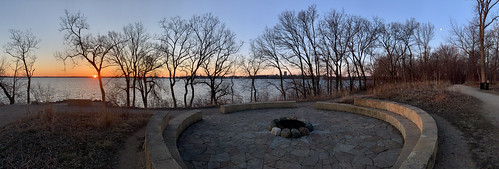
... you can write about anything.
That's a panorama view that shows the sun and the moon. Click and click again to get a big enough picture.
"... to switch them on, and it’s almost impossible to do that when all you’re getting is a glimpse through the gaps in a crowd."
Writes Blake Gopnik in "Experiencing Museums as They Should Be: Gloriously Empty/A critic discovers the joy of visiting Covid-restricted art collections, which lets him commune with van Gogh and the gang" (NYT).
This essay belongs in the transgressive literary genre, The Blessings of Covid.
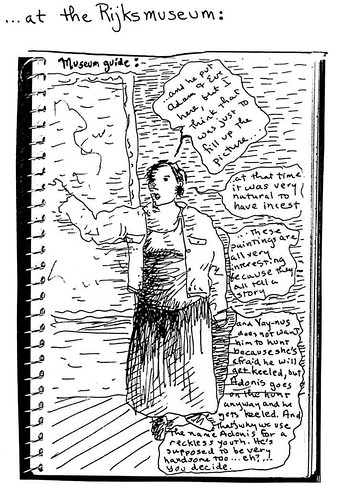
Have you spent much time gazing at museum art, anticipating lofty thoughts and emotional transport? It's hard to experience the contemplative level of awareness needed when there are always other people shifting around you, taking too little time, shattering your meditation with pointless little comments. Like reading the title of the painting out loud. Ever notice how many museum-goers do that? Or flatly stating the same factoid about the artist — the cut-off ear, the penchant for young girls...? They'll take a gander and pronounce the artist good at details. They'll opine on the looks of the person in the portrait as if it were a TikTok makeup video. The word "gorgeous" will recur so much that your meditation shifts to predicting the next time someone will say "gorgeous." And God forbid that painting you wanted as your own personal thinking machine is the next target of the wandering docent....
Says one of the commenters on the Washington Post article "New York authorities file hate-crime charges in attack on Asian American woman."
There isn't even an attacker in the headline. The only human beings in the headline are the "authorities" and the "Asian American woman." The evildoer disappears. There's no attacker, only an "attack." But if there are hate crime charges, then the human mind is all important. "Attack" stresses the outward action. "Hate" requires a hater. There is a shadow of a person in the word "hate," the gesture at a mind.
But this person is depersonalized — depersonalized because he is black. If a white man had stomped on an old Asian-American lady, he'd get full recognition in the headline. Is that racist?
"... when he was an undergraduate there, whose questions and comments were most hostile to the NCAA. Kavanaugh told [NCAA lawyer Seth] Waxman that he was starting from the premise that U.S. antitrust laws 'should not be a cover for exploitation of the student-athletes.' Kavanaugh then summarized the case as one in which the schools were conspiring with their competitors 'to pay no salaries to the workers who are making the schools billions of dollars on the theory that consumers want the schools to pay their workers nothing.' Such a scenario, Kavanaugh concluded, 'seems entirely circular and even somewhat disturbing.'"
From "Justices employ full-court press in dispute over college athlete compensation" (SCOTUSblog).
I'm have twitchy twinges of nostalgia reading this from Sebastian Smee in The Washington Post:
Twombly’s restive, twitchy marks are cryptic, conjuring both the fog of battle and an atmosphere of human and creative fade-out. The “math” part of “aftermath” is old German for “mowing.” And there’s a sense in which Twombly’s work relates to the Old Masters as a field of stubble relates to a golden wheat field in high summer.
Even the headline is a throwback to the distant past: "Yes, your kid could (probably) do this. But it might still be great art." That was the cartoon of the time: Ordinary people looking at "modern art" and saying "My kid could do that." It's kind of sad that the headline writer drew from that long-faded meme.
Who has cared in the last quarter century about the shock of "modern art" in the form of paintings that have messy-looking drips and scrawls and blotches? There are things in art that can still shock people, but it would need to involve hurting a living creature or destroying something of value, not merely the chaotic application of paint to a canvas.
But I am touched by Smee's writerly efforts in an archaic style.
Isn't it racist to require vaccination passports when so many Black citizens don't have government IDs? If you don't have ID, how can you prove it was you who got vaccinated?
— Scott Adams (@ScottAdamsSays) April 1, 2021
"... the man who advertised himself routinely as 'virile, vigorous and potent' was most famous for underperforming. He was brilliant at scheming but lousy at pulling off schemes.... A week after the [Watergate] break-in, Nixon said privately of Liddy: 'He just isn’t well screwed-on, is he?' Liddy may have died Tuesday at 90, but he lives on in any number of characters afflicting our politics with their theatrical machismo or numbskulled shenanigans. There’s a little Liddy in the Republican senators who dressed in safari gear to visit the border last week in armed riverboats. There’s a little Liddy in New York Gov. Andrew M. Cuomo and his hatchet men, who aren’t subtle about conducting loyalty tests or smearing opponents. TrumpWorld teemed with little Liddys trying to outdo one another with displays of bravado, running off cliffs like Wile E. Coyotes, rigging political bombs that detonated in their faces. Roger Stone, Paul Manafort, Michael Cohen, Rudolph Giuliani. Absent-minded masterminds, all of them, tripping on their own cloaks, daggering their own shanks..."
From "Little Liddys everywhere: The legacy of a political ‘super-klutz’" by Dan Zak (WaPo).
Lara Trump, a new Fox News contributor, posted a video of herself interviewing Mr Trump on a range of issues. She later posted a screenshot of an email she received from Facebook warning her of the ban. "In line with the block we placed on Donald Trump's Facebook and Instagram accounts, further content posted in the voice of Donald Trump will be removed and result in additional limitations on the account," an email from "Katelyn" read.
It's possible that Facebook only means to block Trump from directly using another person to bypass the ban, but the phrasing — "content posted in the voice of Donald Trump" — seems to rope in everyone who writes about Trump in a way that passes along his words and ideas. What is "the voice of Donald Trump"?
If I put up a video of Trump talking, am I posting "in the voice of Donald Trump"? Notice the threat of "additional limitations" on one's account. It's not just Lara Trump who is threatened. It's anyone who's pro-Trump and even anyone who wants to write about what Trump is saying.
Is it Facebook's agenda to stop Trump family and associates from passing along his video or is it to create an enclave in which Trump does not exist — to render Trump a nonperson?